Introduction
Remember the days when signing documents were full of chasing papers, printing, scanning, misplacements, losing records, and searching for hours. While those days are already gone with electronic and digital signatures, which promise speed, simplicity, and compliance in the current digital world, where every minute counts and documents matter.
But is it as simple as it looks for the FDA-regulated industries like pharmaceuticals, biotechnology, medical device manufacturers, etc, to choose a suitable digital signing software?
In regulated industries, before we click “Sign,” it is important to ask whether the digital signing software is compliant with 21 CFR Part 11. Therefore, any random digital signing software cannot be selected but only a 21 CFR Part 11 compliant digital signature with other essential features can be suitable for regulated industries.
What is 21 CFR Part 11?
21 CFR Part 11 is issued by the United States’ FDA (Food and Drug Administration) that defines regulations for electronic records and electronic signatures. This regulation ensures that the electronic records and electronic signatures have integrity, accountability, and trustworthiness equal to paper records and handwritten signatures.
21 CFR Part 11 has three main areas:
- Electronic records
- Electronic signature
- Audit Trail
21 CFR Part 11 provides regulations on how any data should be created, modified, transmitted, stored, retrieved, etc, without losing its integrity and traceability. This regulation includes digital system validation, system access control, and documented proof of electronic signature being linked with the user/signer.
21 CFR Part 11 applies to the regulated industries like pharmaceuticals, biotechnology, medical devices, etc, if these industries want to transform and go digital for their records and signatures to keep them audit-ready, compliant, legally binding, and secure.
If you’re new to the concept, you can explore our detailed guide on 21 CFR Part 11 electronic signature requirements to understand its scope and compliance essentials.
Why FDA’s 21 CFR Part 11 Compliant Software is Critical in Regulated Industries
The growing enforcement of data integrity standards has made it essential for companies to adopt FDA compliant digital signature solutions that ensure traceability, validation, and secure access across all regulated workflows.
Let’s have a look at the amount and percentages of impact a regulated industry has suffered due to a lack of non-compliance with the FDA’s 21 CFR Part 11, CFR Part 11 validation, and proper compliant digital signing software
According to an analysis by Redica Systems, data integrity violations were a growing focus in FDA drug GMP warning letters in both FY2020 and FY2021, after several years of decline, highlighting the agency’s increasing scrutiny of electronic records systems.
In 2024, the FDA’s Center for Devices and Radiological Health issued 529 warning letters, with 8% (44) sent to medical device manufacturers for data integrity and validation issues is a key reason for penalties and financial losses.
In September 2024, the U.S. Securities and Exchange Commission (SEC) charged Cassava Sciences and its executives with data manipulation and a lack of transparency in clinical research. It was fined $40 million, with individual executive fines ranging from $50,000 to $175,000.
The 2024 State of Validation Report shows that 61% of organizations experienced an increase in validation workload over the past year, and nearly half (47%) plan to increase validation budgets in the coming year.
Complying with 21 CFR part 11 is more than just ticking a check box; it is important for regulated industries, as under:
- Audit-readiness with proper audit trails for every action and activity performed.
- Protects data integrity and security with tamper-proof and accurate data, with only authorized persons having access to the system.
- Provides legal validity by making electronic records and signatures equally valid as paper records and handwritten signatures.
- Provides operational efficiency by reducing paperwork, manual errors, approval delays, and saving costs associated with it.
- Built trust and accountability by ensuring that the industry is operating with transparency, accountability, and quality.
- Ensure compliance and penalties avoidance with digital signing software, which helps in ongoing certification and market approval and avoids operational halts, penalties, shutdowns, reputational damage, product recall, etc.
- Provides market credibility and trust with software committed to product quality and regulatory standards, and builds trust with regulators, customers, and partners.
Top Features to Look for in a 21 CFR Part 11 Compliant Digital Signature Tool
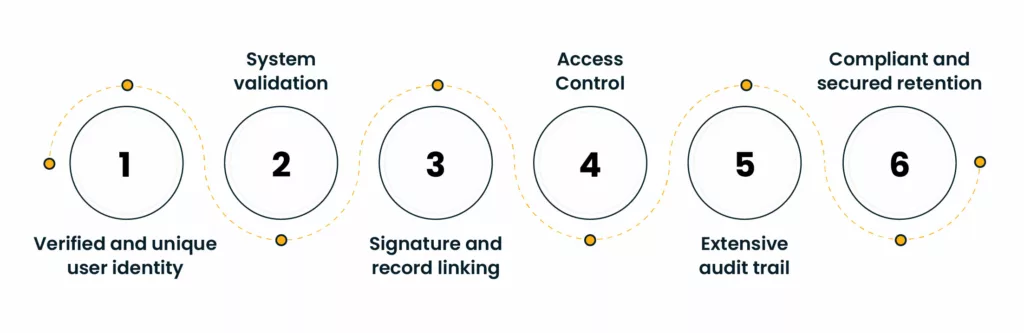
Here is the list of top features an organization should look for in a 21 CFR Part 11 compliant digital signature tool:
Verified and unique user identity
The signer’s identity should be verified, authenticated, and unique, having distinct login credentials and a password. There can be two/multi-factor authentication, such as having an access code/PIN along with a password.
System validation
The system validation is important to ensure its compliance with 21 CFR Part 11, and the vendor should provide validation certificates, performance assessment reports, and testing records.
Signature and record linking
The signature should provide the full name of the signer, the date and time of signing, and the purpose, such as approval, review, etc, of the signature. Further, the signature should be permanently linked with the respective record without any detachment or substitution to maintain the integrity of the document.
Access Control
The digital signature tool should have role-based access management to view, access, sign, or approve records to avoid any unauthorized access or forged signature on sensitive documents.
Extensive audit trail
The signature should have active logs of who and when signed, what was changed, timestamping of each signature, and activity to have detailed audit trails and be FDA audit-ready.
Compliant and secured retention
The solution should ensure long-term storage and easy retrieval of signed records without loss of data integrity. It must also maintain version control to prevent accidental overwriting or deletion.
Mistakes to Avoid When Selecting a 21 CFR Part 11 Compliant Digital Signing Software
Mistakes regulatory authority should avoid while selecting a 21 CFR Part 11 Compliant Digital Signing Software are as under:
- Don’t choose price over compliance because some software may be cost-savvy, but many may not be as per regulatory standards.
- Ignoring system validation can fail an organization in FDA audits, even if the tools have other great features. The vendor must provide a validation report for the system and process.
- Don’t assume a secured tool can be a compliant tool. Always verify compliance documentation and audit features.
- Selecting software is not exclusively IT task, so avoiding involvement of compliance, regulatory or quality assurance team would not favour in ideal software selection.
- There should not be shared logins, a lack of identification verification, weak password policies, etc, as it can be a major non-compliance issue.
- Neglecting a few requirements, such as audit trails, compliant record retention and retrieval, etc, can cause penalties and fines to the industry.
How to Evaluate a 21 CFR Part 11 Digital Signing Software Vendor
Having compliant digital signing software is not enough; evaluation of the vendor is equally important to ensure that the organization does not face any non-compliance issues. Here is a list of evaluation organizations that organizations should consider before selecting an ideal vendor and digital signing software
- Verify the vendor’s experience in FDA-compliant software services. Check testimonials, case studies, or references from other FDA-regulated organizations to confirm a reliable and proven track record.
- Understand the vendor’s knowledge and the expertise of their teams regarding 21 CFR Part 11, GxP, GAMP-5 guidelines, and other regulatory compliance.
- Verify documents that confirm the system is correctly installed, tested, and performs according to regulations.
- Verify how the vendor handles storage, encryption, data authentication, security of data at rest or in transit, etc.
- Ensure the level of training, demos, manuals, tutorials, etc, that the vendor provides for software learning.
- Examine the level of support the vendor provides for any technical glitches, queries, system failures, or regulatory updates.
- Check whether the vendor provides required certification and reports as required for regulatory compliance.
Conclusion
To sum up, a 21 CFR Part 11 compliant digital signature tool goes beyond just being convenient. It helps maintain trust, accountability, and data integrity with every electronic approval. Choosing the right features, assessing vendors, and steering clear of common mistakes allow organizations to meet regulations and improve operations as they grow digitally.
